Air conditioners have become an essential part of residential, commercial, and industrial spaces. During hot weather, an AC helps maintain a comfortable indoor temperature by removing heat from inside and keeping a room cool by transferring it outside. But many people ask: How does an Air Conditioner work?
The working principle of an air conditioner is based on the refrigeration cycle. An AC does not simply produce cold air. Instead, it removes heat from indoor air, cools the air through the refrigeration process, and circulates the conditioned air back into the room.
How Does an Air Conditioner Work?
The basic working of an air conditioner involves four major components:
- Compressor
- Condenser
- Expansion Valve
- Evaporator Coil
These components work together in a continuous refrigeration cycle. A special fluid called refrigerant circulates through the AC system and absorbs heat from indoor air before releasing it outside.
The complete AC working process can be understood in simple stages.
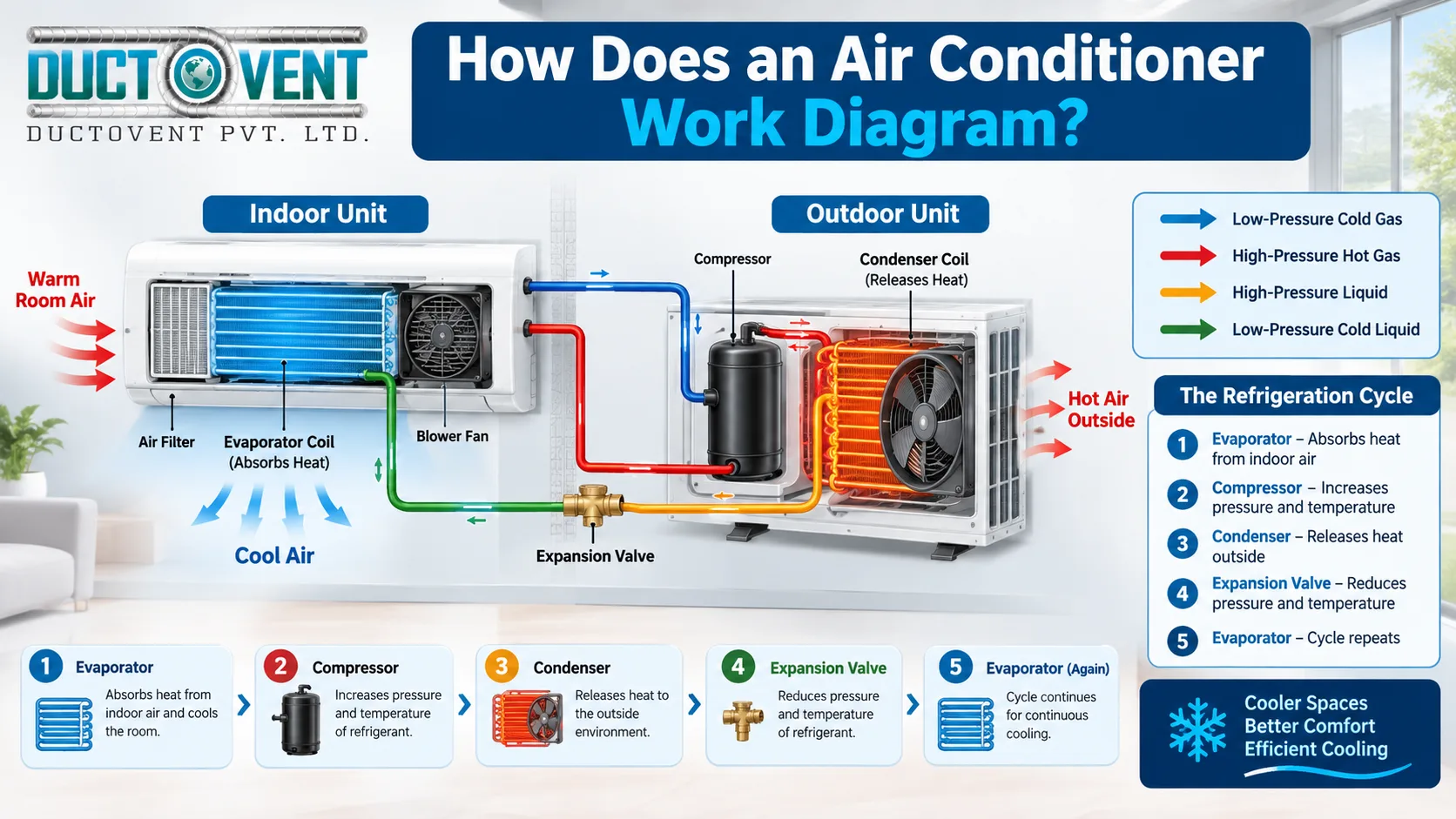
Air Conditioner Working Diagram
A basic AC System Diagram follows this cycle:
Indoor Air → Evaporator Coil → Cool Air → Room
Refrigerant Cycle:
Evaporator → Compressor → Condenser → Expansion Valve → Evaporator
Simple AC Working Diagram
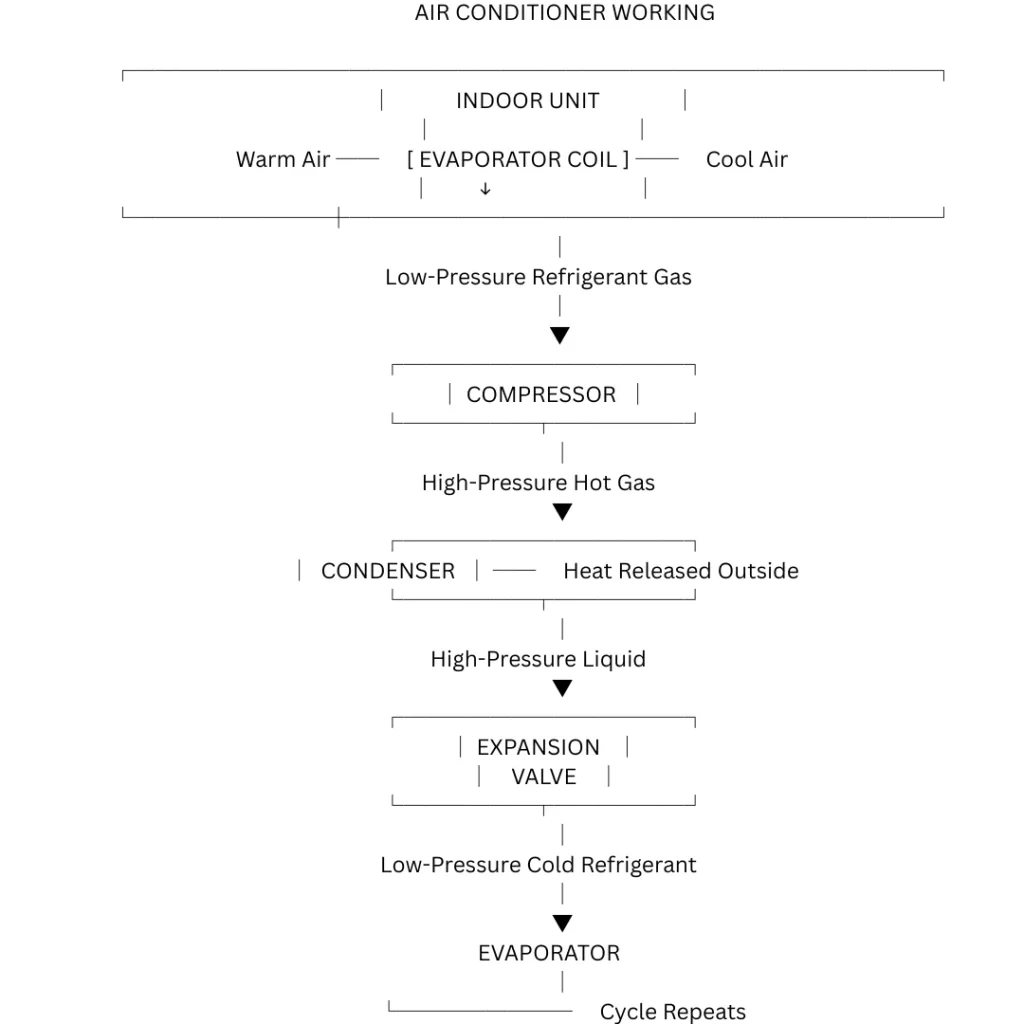
Main Components of an Air Conditioning System
1. Compressor – The Heart of the AC System
The compressor is one of the most important components of an air conditioner. It is generally located in the outdoor unit of a split AC system.
The refrigerant enters the compressor as a low-pressure gas. The compressor compresses this refrigerant, increasing its pressure and temperature.
After compression, the refrigerant becomes a high-pressure and high-temperature gas. It then moves toward the condenser.
The compressor helps maintain the continuous movement of refrigerant throughout the complete AC system.
2. Condenser – Releases Heat Outside
The condenser is also generally located in the outdoor unit. The hot, high-pressure refrigerant gas enters the condenser coil.
A fan moves outdoor air across the condenser coil. As the refrigerant releases its heat to the outside environment, it starts cooling down.
During this process, the refrigerant changes from a hot gas into a high-pressure liquid.
This is an important stage because the heat removed from the indoor room is finally released into the outside environment.
3. Expansion Valve – Reduces Refrigerant Pressure
After leaving the condenser, the refrigerant is in a high-pressure liquid state. Before entering the evaporator, its pressure must be reduced.
The expansion valve controls the flow of refrigerant and reduces its pressure.
When the pressure decreases, the temperature of the refrigerant also drops significantly. The refrigerant then becomes cold and is ready to absorb heat inside the indoor unit.
The cooled refrigerant moves toward the evaporator coil.
4. Evaporator Coil – Absorbs Heat from Indoor Air
The evaporator coil is located inside the indoor unit of the air conditioner.
A fan draws warm air from the room and passes it over the cold evaporator coil. The refrigerant inside the evaporator absorbs heat from the indoor air.
As heat is removed, the air becomes cooler. The cooled air is then circulated back into the room.
At the same time, the refrigerant absorbs heat and changes from a low-pressure liquid into a low-pressure gas.
The refrigerant then travels back to the compressor, and the complete cycle starts again.
Step-by-Step AC Working Process
Understanding the AC working process becomes easier when divided into simple steps.
Step 1: Warm Air Is Drawn into the AC
The indoor unit draws warm air from the room through the return air section. The air passes through filters that help remove dust and other particles.
The filtered air then moves toward the evaporator coil.
Step 2: Evaporator Absorbs Heat
The cold refrigerant flowing through the evaporator coil absorbs heat from the warm indoor air.
As the air loses heat, its temperature decreases.
Step 3: Cool Air Is Supplied Back
A blower or fan circulates the cooled air back into the room.
In larger HVAC systems, the cooled air may travel through an air duct system before reaching different rooms or areas.
Step 4: Refrigerant Moves to the Compressor
After absorbing heat, the refrigerant becomes a low-pressure gas and moves toward the compressor.
The compressor increases its pressure and temperature.
Step 5: Condenser Releases Heat
The hot refrigerant moves through the condenser, where heat is released to the outdoor air.
The refrigerant then changes into a high-pressure liquid.
Step 6: Expansion Valve Cools the Refrigerant
The refrigerant passes through the expansion valve, where its pressure and temperature decrease.
It then enters the evaporator again to repeat the cooling cycle.
How Does an AC Cool the Air?
An air conditioner cools indoor air by removing heat, not by directly creating cold air.
The evaporator coil absorbs heat from the room. The refrigerant carries this heat through the system to the outdoor unit.
The condenser then releases the collected heat outside.
This continuous transfer of heat creates a comfortable indoor environment.
Therefore, the basic principle of air conditioning can be explained as:
Heat Absorption Indoors → Heat Transfer Through Refrigerant → Heat Release Outdoors
Role of Air Ducts in an Air Conditioning System
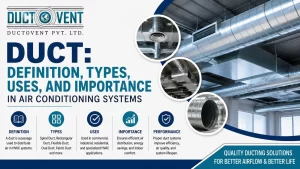
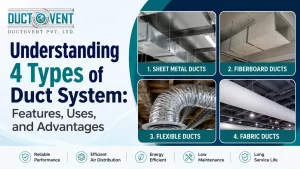
Air ducts are an important part of central air-conditioning and HVAC systems. While a split AC directly supplies air into a room, central air-conditioning systems use a network of ducts to distribute conditioned air.
The duct system carries cooled or heated air from the air handling unit to different areas of a building.
A properly designed duct system helps provide:
- Efficient air distribution
- Uniform cooling
- Better airflow
- Reduced air leakage
- Improved indoor comfort
- Effective HVAC performance
Ductovent, as a Duct Manufacturer, focuses on providing ducting solutions for HVAC and air-conditioning applications. Properly manufactured various industrial ducts can help support smooth airflow and efficient air distribution throughout commercial and industrial facilities.
Supply Air and Return Air in a Ducted AC System
A ducted air-conditioning system generally uses two important airflow paths.
Supply Air
Supply air refers to the cooled or conditioned air delivered from the AC system into a room or building area.
The air travels through supply ducts and is released through air outlets or diffusers.
Return Air
Return air is the warmer air collected from the indoor space and sent back to the air-conditioning system.
This air passes through the return duct and enters the air handling unit for further cooling.
The continuous movement of supply and return air helps maintain proper air circulation.
Importance of Proper Duct Design
The performance of a central air-conditioning system depends on more than the AC unit. The duct system should also be properly designed and manufactured.
Poorly designed ducts can cause problems such as:
- Uneven cooling
- Air leakage
- Low airflow
- Increased energy consumption
- Noise problems
- Reduced comfort
Proper duct sizing helps maintain suitable airflow throughout the system. The duct layout should also be designed to reduce unnecessary resistance and pressure loss.
As a professional duct manufacturer, Ductovent understands the importance of proper duct fabrication for different HVAC applications.
How Air Filters Help in AC Working
Air filters are another important part of an air-conditioning system.
Before indoor air reaches the evaporator coil, it generally passes through an air filter. The filter helps capture dust, dirt, and airborne particles.
Clean filters help improve airflow and support efficient AC performance.
When filters become dirty, the airflow may be reduced. This can affect cooling performance and increase the load on the system.
Regular cleaning and replacement of filters are therefore important for proper AC operation.
Does an Air Conditioner Also Remove Humidity?
Yes, an air conditioner can also help reduce indoor humidity.
When warm and humid air passes over the cold evaporator coil, moisture in the air can condense on the surface of the coil.
This condensed water is collected and drained through the AC drainage system.
As a result, the air becomes not only cooler but also less humid.
Humidity control helps improve indoor comfort, especially during hot and humid weather conditions.
Types of Air Conditioning Systems
Different types of air-conditioning systems are available according to the application and cooling requirements.
Window Air Conditioner
A window AC contains most of the major components in a single unit. It is commonly used for small rooms.
Split Air Conditioner
A split AC consists of an indoor unit and an outdoor unit. It is widely used in homes, offices, and commercial spaces.
Central Air Conditioning System
Central AC systems are commonly used in large buildings. Conditioned air is distributed to different areas through ducts.
Ducted Air Conditioning System
Ducted systems use a network of air ducts to distribute conditioned air. They are suitable for commercial buildings, offices, hotels, hospitals, and industrial facilities.
Importance of Duct Quality in HVAC Systems
Duct quality can influence the overall performance of an HVAC system. A properly manufactured duct helps maintain the designed airflow path and supports efficient air distribution.
The duct material and fabrication quality should be selected according to the application requirements.
Important considerations include:
- Duct size
- Material quality
- Proper fabrication
- Air leakage control
- Duct insulation
- Smooth airflow path
- Proper installation
Ductovent provides duct manufacturing solutions with a focus on the requirements of modern HVAC and air-conditioning systems.
Why Understanding AC Working Is Important
Understanding how an Air Conditioner works can help users operate and maintain their systems more effectively.
Basic knowledge of the AC system helps users understand:
- Why regular maintenance is important
- How refrigerant circulates
- Why filters need cleaning
- How heat is removed from a room
- Why outdoor units release heat
- How ducts distribute conditioned air
Regular maintenance can help improve cooling performance and support the long-term operation of the air-conditioning system.
Conclusion: How Does an Air Conditioner Work?
The working of an air conditioner is based on a continuous refrigeration cycle involving the compressor, condenser, expansion valve, and evaporator coil. The refrigerant absorbs heat from indoor air, carries the heat through the AC system, and releases it outside.
The basic AC working process can be summarized as:
Indoor Heat Absorption → Refrigerant Compression → Outdoor Heat Release → Refrigerant Cooling → Indoor Cooling
In central and ducted HVAC systems, air ducts play an essential role in distributing conditioned air efficiently throughout a building. Ductovent, as a reliable duct manufacturer, provides ducting solutions designed to support effective airflow and air distribution for different air-conditioning and HVAC applications.
For an efficient and comfortable working environment, it is important to have a properly designed AC system combined with quality components and efficient ductwork. A well-planned HVAC system helps ensure effective airflow, reliable cooling, improved indoor comfort, and smooth overall system performance.